Showing posts with label Woody Allen. Show all posts

Tuesday, February 14, 2012

And The Loser Is... #13- An island unto himself

Back in ATLI... #4, I began to take a look at the Academy Awards successes of my all-time favourite filmmaker, Woody Allen. I'm going to continue that here, starting with what I consider to be the finest of all his movies, Manhattan (1979).

This was actually my introduction to Allen's work, and I can't really think of a better one. The opening sequence, featuring the film's protagonist, Isaac Davis (Allen), reciting the opening passage of his new book over a series of stills of New York City, in many ways encapsulates Woody's work in general, and tells you everything you need to know about how he operates as a filmmaker, and an on-screen persona. Consider the content of the narrative, establishing at once the sexual voraciousness of the Allen persona, his moral values, including his reverence of the common New Yorker, his brand of self-deprecating humour, and, perhaps most importantly, his adoration of New York City. The sequence also establishes Allen's artistic sensibilities, through his choice of the George Gershwin piece, 'Rhapsody in Blue', as well as through Gordon Willis' black and white photography.

The film itself is one of Allen's funniest, and most romantic, as well as one of his most optimistic, albeit cautious optimism. Isaac, a writer, has an ex-wife who is writing a tell-all book on their marriage, and a 17-year-old girlfriend, Tracy (played by Mariel Hemingway, who was nominated for the best supporting actress award in 1980). He is unsettled by the 25 year age difference between them, and, when he meets Mary (Diane Keaton), his best friend's mistress, he finds himself falling for her. I talked last time about the way Allen depicts intellectualism in his films, which is largely very critical, and we see this again here. Mary is very intellectually agressive, very forceful with her opinions ("I'm honest, whaddya want? I say what's on my mind and, if you can't take it, well then fuck off!"), which is in stark contrast to the very sweet, besotted Tracy. It is this that, upon their first meeting, turns Isaac off Mary, but eventually he sees her as a woman, not only closer to his own age, but also who can offer him more on an intellectual level. As is the case in so many Allen films, though, this intellectualism is ultimately shown as being self-destructive, and a sure path to unhappiness.

This film is really interesting in terms of how the Allen persona reacts in relationship to a more intellectually-dominant female. We see an Allen much more connected to his humble beginnings in Brooklyn, much more connected to the streets of New York. In one scene, a guest at a party talks about the Times running a 'devestating' satirical piece about an upcoming Nazi march, prompting Davis' response of "Well, a satirical piece in the Times is one thing, but bricks and baseball bats really gets right to the point". In other scene, Mary talks about her genius ex-husband, to which Isaac replies, "Oh really, he was a genius, Helen's a genius and Dennis is a genius. You know a lot of geniuses, y'know. You should meet some stupid people once in a while, y'know, you could learn something." These scenes show a disconnect between Allen and the true New York intellectual, but there are instances where he is betrayed by his own love of high art, which separate him from men of his class (such as referring to Mary's friends as being "like the cast of a Fellini movie"). The Allen persona, as stated by Alvy in Annie Hall, really is an island unto himself.
Mariel Hemingway in Manhattan.
In the end, Isaac sees that he was only truly happy when he was with Tracy, which leads to one of the most hopeful conclusions to an Allen film. It isn't exactly a fairytale ending, as Tracy is leaving to study in London, but her, and the film's, final words of "not everybody gets corrupted. You have to have a little faith in people" are a clear message that happiness is attainable when you free your mind of cynicism. Hemingway is a revelation as Tracy, and I think she deserved the Oscar over Meryl Streep (who also features in Manhattan, but won the award for her performance in Kramer Vs. Kramer).

Manhattan is sweet, funny, and has some beautiful cinematography, and is an easy 5 star film.

One of Allen's most successful films as the awards is the 7-times nominated, 3-times winner, Hannah and Her Sisters (1986). Woody was nominated for best direction, and the film also picked up a best picture nomination, but was pipped in both categories by Oliver Stone and Platoon. This is a superior film, and is also one of the best directed of all of Allen's films, as he deftly weaves together a multi-threaded story, part-comedic, part-dramatic, about three sisters and the extended family that surround them.

Supporting stars Diane Wiest and Michael Caine both picked up awards for their performances here. Caine plays the husband of Hannah (Mia Farrow), who is secretly in love with Hannah's younger-sister, Lee (Barbara Hershey). The dynamic between the sisters is very similar to that between the sisters in Interiors (1978), with Hannah as the ultra-successful to the point of being annoying sister, and Wiest as the sister who just can't seem to find a way to express herself. Allen takes more of a supporting role, as the ex-husband of Hannah, who believes that he is dying and wants to find some inner-peace to help him cope.

We are family...
This was an ambitious undertaking from Allen, more known for intimate works, and has a different tone to much of his earlier work (in large part due to the shifts in focus from character to character, as well as the blending of the comedic elements, which generally feature Woody himself, and the dramatic elements). Allen assembled one of his most impressive ensembles for the film (it must have been a thrill to work with Ingmar Bergman mainstay, Max von Sydow), and the camerawork from Carlo Di Palma is some of the most assured you'll see in an Allen film. This is truly intelligent filmmaking, and I give the film 5 stars.

Jumping forward now, to the last Woody Allen film to gain the attention of the Academy, 2008's Vicky Cristina Barcelona. This was part of Allen's late-career tributes to the great cities of Europe, which also includes Midnight in Paris (2011), and his various London-set films, including 2005's Match Point, which also featured Vicky Cristina Barcelona star, Scarlett Johansson. This is also the film which, at that point, I considered to be the best of Allen's so-called comeback years.

Vicky and Cristina (Rebecca Hall and Johansson, respectively) are two friends who take a trip to Spain and attract the attention of a sexually aggressive artist, Juan Antonio, played by Javier Bardem. Vicky is conservative in nature, and holds herself back from being romanced by the mysterious stranger, but the adventurous Cristina jumps into an exciting affair, which is soon complicated by the arrival on the scene of Juan Antonio's tempestuous ex-wife, Maria Elena. Penelope Cruz won the best supporting actress Oscar in 2009 for her portrayal as Maria Elena, and thoroughly deserved it was too. Slipping effortlessly between English and Spanish, Cruz is electric, playing Maria Elena with a wild, unabashed sexuality which brings to mind Beatrice Dalle's performance as the titular heroine in Betty Blue (1986).

Hall and Johansson are both weak in their roles, so it isn't until Bardem and Cruz hit the scene that this really gets rolling. But when it does, it's as sexually charged and exciting as anything Woody has ever done. It also looks great, the sun-drenched Spanish setting a far cry from the typical grey/green tones of Allen's New York-set films. It seems nowadays that Allen has found a new niche for himself, away from the comedies on which he made his name, and even the intellectually-based Bergman-inspired drama of his 1980s work. The best Allen films now are slightly unrestrained, where characters have a hard time keeping a hold of their emotions, and are all the better for it. It's like going abroad opened up a different side to Woody, and it's interesting to see him explore this side- certainly as long as the results are this good. 4 stars.

It was my oroginal intent to cover all of Allen's career in two parts, but it seems I will have to extend this into another blog, so look for part 3 at a later date. Until then, here's looking at you.

Wednesday, February 1, 2012

And The Loser Is... #10- Past Lives

The 2012 Academy Awards nominees were announced last week, and, while I'm yet to see the majority of the films up for awards, the announcement did present some intriguing battles. Not least of which is the battle for the best director Oscar, which, amongst its five nominees, includes three of America's finest living directors; Woody Allen, Terrence Malick, and Martin Scorsese.

It is the former two who are the focus of this edition of ATLI..., as Allen's Midnight In Paris, and Malick's The Tree of Life are the only two films from the list of nominees that I've seen. Now, as well as being amongst the finest of American directors (in fact, they are amongst the finest of directors worldwide), Allen and Malick are also two of my personal favourite filmmakers. This despite being polar opposites in a lot of ways. Allen, for example, is a prolific filmmaker who has averaged just about a film every year since he began his directing career proper in 1969 (I generally discount 1966's What's Up, Tiger Lily?). On the other hand, Malick, famously reclusive, has directed just five films in his 39 year career (amazingly, and excitingly, he has four projects currently in the works, so maybe he's making up for lost time).

The differences don't stop at work ethic; Allen's films are generally intimate, simplistic affairs, whereas Malick deals in the epic; Allen is very much an urban director, Malick's films focus on the great outdoors, nature and landscape; Allen's films are verbose, most of the dialogue in Malick's films is featured on a narrative track. Still, they are both key American filmmakers, with a unique vision of the place they call home.

I will start then, with Woody Allen's Midnight In Paris, the latest in Allen's recent odes to the great cities of the Europe (London in Match Point, Barcelona in Vicky Cristina Barcelona). This time it is the French capital, of course, which gets the treatment, and I will start by saying this is possibly Allen's most romantic film since 1979's Manhattan.

Owen Wilson was dreaming of the past.
The film stars Owen Wilson (the best in a long line of Woody surrogates, surprisingly likeable and charming) as Gil, a young writer who, along with his fiancee, Inez (Rachel McAdams) and her family, is in Paris on business. Gil is disappointed with his career as a hack-y, but successful, Hollywood writer, and dreams of writing a novel; Inez appears supportive, but doesn't shy away from telling Gil that he is a hopeless romantic, who should be happy with the success he has. This difference in outlook is magnified when Gil begins to fall in love with the city, and expresses his desire to move there and write, like many great American artists of the 1920s.

This is when the film takes a magical turn, as, one night while taking a midnight stroll, Gil discovers that he has indeed been transported back to the 20s, a time of Scott and Zelda Fitzgerald, Cole Porter, and Gertrude Stein. In this time period he gets writing advice from Ernest Hemingway, and becomes besotted with Adriana, the lover of Pablo Picasso (played by a radiant Marion Cotillard).

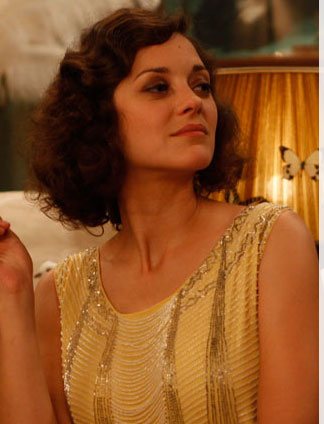
Cotillard: that obscure object of desire.
The scenes of 20s Paris are some of the most beautiful that Allen has ever filmed, and he truly captures the romanticism of the era. It's also fun to look out for the familiar names who crop up at the various parties that Gil attends (in one stand out scene, he is accosted in a coffee shop by Man Ray, Salvador Dali and Luis Bunuel). It is clear that Allen has a genuine soft spot for the era, and that comes through on the screen, aided by the cinematography of Johanne Debas and Darius Khonji, as well as the art and costume team.

While Gil falls more and more in love with old Paris, and more and more infatuated with Adriana, so too he grows further away from Inez. Their relationship represents a typical theme of Allen's films, the battle between the cold and intellectual (here represented by Inez, her family, and her know-it-all friend, played by Michael Sheen) and the magical and romantic (of course, represented by Gil). I mentioned in ATLI... #4, the first part of my look at Allen's Oscar successes, that for a director who is often cited as being intellectual, he shows a lot of disdain for that lifestyle, and actually exalts the fanciful, and even simple-mindedness.

Another favourite Allen theme is the preoccupation with magic, and fantasy, which we can see in his work going back to '82's A Midsummer Night's Sex Comedy. I often find that to be the element of Allen's work that I least enjoy, but here he fully pulls it off, crafting a real sense of wonder and romance where it would have been easy to appear insincere, or even hokey.

This film is also up for best picture, has been widely critically acclaimed, and is Allen's most profitable film ever. I think it's his best work since at least Sweet and Lowdown (1998), possibly going back even further. In short, it's wonderful; a light and funny ode to love, art and the importance of having a dream. 4 stars.

The Tree of Life, also up for best picture on top of Malick's nomination, is anything but light, and virtually impossible to summarise. It focuses, in vignette form, on a Texas family in the 1950s, while jumping forward to reveal the fate of the eldest son, and also jumping back in time to the origin of the life. Yes, you read that right; this film shows the creation of the life on Earth. In many ways, this is the spiritual brother of Kubrick's 2001: A Space Odyssey, another film that splits opinions, but is so wide in scope and imagination that it is hard not to admire.

For those unfamiliar with Malick's work, he is a filmmaker who has a very particular way of telling stories. His films are very poetic. They have a mythical quality to them, that allows Malick to indulge in his obvious reverence for the beauty of nature. It would be wrong to say that his films are challenging in the narrative sense; despite the odd rhythm that his films exhibit, slowly down to focus on small details, and then jumping ahead in time, they all follow a linear structure. This film is different though. This is challenging. At times it's hard to get a foothold in the film, to get a sense of what we are seeing and what its importance is. We might jump from a scene of the family patriarch trying to teach his children how to fight on their front lawn, to a scene of a Jurassic-era rainforest, where we linger, taking in the sights and sounds. In one scene (for me, the most captivating and beautiful of the whole film, and possibly of any film) we linger for several moments on a dinosaur, lying alone on a beach. It's hard to know what this represents, why Malick chose to include it, but watching it you feel a strange affinity to this lone creature, long extinct, and it does draw up questions of where we came from, and what are we doing here.
Brad Pitt exhibits tough love.
The more straightforward and conventional sequences in the film focus on the relationship between the three children, their free-spirited mother (played by Jessica Chastain), and their often cruel father (Brad Pitt). In the modern day, the eldest boy is portrayed by Sean Penn, and is struggling to come to terms with the way he was raised. Even in these scenes, events take on a dreamlike quality. There is a sparsity of dialogue, and we jump from one sequence to the next. The Pitt character is the most interesting; a man who you feel has a genuine love for his boys, but often finds that the best way to express it is in teaching them about the hardships of life. It is a character, and performance, which resonates, beyond any other in the film.

It is safe to say that this is not for everybody, evident by the number of walk-outs during its first weeks of exhibition in the USA, but I believe it will stand the test of time as a fine achievement in cinema, and in art. It's a film that has the power to provoke serious thought as to what it means to be human, to love and to hate. The cinematography is stunning, thanks to the Oscar-nominated work of Emmanuel Lubezki, who also worked with Malick on The New World in 2005. I give this film 4 stars, but I could easily see going with 5 after a repeat viewing.

I'm extremely pleased that both of these films, and directors, have been recognised this year. I can't see either winning, but if I had my way, I would like Allen to pick up the best director award, and The Tree of Life to be named best picture, just because it would be a completely out-of-character pick for the Academy.

I should have a new film to review for ATLI... #11, but until then, here's looking at you.

Monday, January 9, 2012

And The Loser Is... #4- Just another Monday night at Michael's

When Annie Hall was announced as the surprising winner of the Best Picture award in 1978, its director, Woody Allen, wasn't on hand to share the celebrations. Allen had earlier been named Best Director for his signature film, but instead of Los Angeles, Allen was hundreds of miles away, in New York, playing with his jazz band at Michael's Pub, just like he did every Monday night. Allen had been resistant towards the whole awards process, at first refusing even to allow the production company, United Artists, to campaign for the film. "If it were a special occasion or something, I might do it," he said of his decision to snub the ceremony.

This is typical of a man who has done things his own way throughout his professional (and personal!) life. However, this attitude towards the Academy Awards (and all awards ceremonies) is clearly not reciprocated, as Allen's films have notched up a number of nominations over the years. This edition of ATLI... will be the first of a two-part look at his various successes.

I became a big Woody Allen fan pretty much from my first exposure to his work, and he soon became my most beloved filmmaker. I have seen every one of his films, up to and including Midnight In Paris (which I'm hoping I'll be talking about in a future blog after this year's nominations are announced), and am rarely disappointed, able to get some enjoyment out of even his weaker efforts (and there have been some). I think my love of Allen comes down to a few key elements. Firstly, he reveres a lot of the same filmmakers as myself (notably Ingmar Bergman), and you can see that reverence play out in his own films, sometimes subtly, sometimes not so. Secondly, he is obviously a very funny man, and great comedy writer. I often think that comedy and beauty are the only two areas of true subjectivity in life. If you find something funny, who am I to say it isn't? Likewise if you find something, or someone, beautiful. And Allen's brand of humour just jives with me in a way that, say, Mel Brooks' doesn't. Finally, I see certain similarities between myself and the Woody Allen persona. Certainly, the themes that he seems preoccupied by, and that recur in his films, as well as certain neurotic elements to his character. I won't go into any more detail about it than that, because the purpose of this blog isn't to talk about myself. It's to talk about films. And, with that said, let's begin this look at Allen's work with the film talked about above, Annie Hall.

As mentioned above, this film won awards for best picture and best director. It also earned Diane Keaton an award for best actress, Allen and Marshall Brickman the award for best original screenplay, and Allen a nomination for best actor. It is really the quintessential Allen film, and the perfect starting point for novices, as it brings together a lot of the elements of his work, framed around a romance, which is a central device in Allen's films. Keaton is the titular Hall, a girl from the Midwest of America who Allen's typical New Yorker, Alvy Singer, meets and falls in love with. The two start a relationship, and the film simply documents that, from their first meeting, to their eventual break-up.

What makes the film so endearing are the different devices Allen uses throughout, which is not something he's done too much of in his career. He plays with the structure of the film, telling the story in flashback, often jumping back and forth in the relationship, and even going back to his childhood. He uses fantasy sequences, such as Annie having an outer-body experience as they prepare to make love, and even uses animation for one scene.

Annie Hall's balcony scene.
Another classic scene shows subtitles appear at the bottom of the screen informing us what the characters are really thinking, as they try to impress each other in the early stages of their relationship. It is this playfulness which I think makes Annie Hall such an enduring film, but its importance in Allen's oeuvre goes beyond that. The director uses the relationship between Alvy and Annie to relate his feelings about New York City, and what it is to be a New Yorker. First, he tries to make Annie into what his idea of a New Yorker is; he encourages her to see an analyst, and to take adult education classes. He has this cerebral idea of the city, and tries to mould Annie to fit this. This backfires, however, when Annie decides that she wants to move to Los Angeles to further her singing career. At this point, we are treated to Allen's far-from-favourable vision of L.A (and, of course, life imitated art when Allen snubbed the Oscars to play jazz in NYC). To Allen, L.A is vast and bright and fake, whereas New York is intimate and honest. He shoots the city in greens and browns, giving it an Autumnal warmth, and uses locations like apartment balconies to show the intimacy of the city. So, as well as the dichotomy between Alvy, the intellectual New Yorker, and Annie, the folksy, oddball Mid-Westerner, you also see Allen's comparison of his own city to Los Angeles. While Manhattan (1979) has often been cited as Allen's love letter to New York City, a grand romantic gesture of a film, this is more like the pillow talk between a happily-married couple, totally at ease in each other's company.

This is a film that I can watch again and again. The number of great lines is endless, from Woody's memorable defence of masturbation (it's sex with someone you love), his comparison of relationships to sharks (they need to be moving forward or they die), to my personal favourite, his reaction to a movie theatre patrons assessment that Marshall McLuhan's writing doesn't hit him on a gut level ("I'd like to hit HIM on a gut level"). Keaton is also fantastic in her much-deserved award-winning role- it's hard not to love her here. This is the perfect romantic comedy. 5 stars.

The next Allen film to gain Academy attention was Interiors, released the year after Annie Hall. This marked a different direction for the director, as it was his first dramatic film and it earned best actress nominations for Geraldine Page and Maureen Stapleton (leading and supporting, respectively), and another best director nom for Woody (also best original script and best art direction noms). This is Woody's homage to Bergman, and it tells the story of three sisters, and their reaction to the divorce of their parents. The main focus of the film is on Mary Beth Hurt's Joey, who tries to make her mother face the reality that her marriage is over. Joey is herself plagued by feelings of inadequacy when she compares her life to that of her two successful sisters (this is a theme Allen would re-examine in Hannah and Her Sisters), and struggles to find a creative outlet to express herself. Key to the film is the relationship between the sisters, and their father's new beau (Stapleton), a lively, almost vulgar woman, in stark contrast to their restrained, intellectual mother. One thing I find interesting about Allen's work is that, despite generally populating his films with intellectuals, and obviously revering high art, his films often look down on intellectualism, or present it as a dead end in terms of finding happiness and true meaning. That is again the case here. It's interesting to see Allen direct a film like this, mimicking a lot of Bergman's framing devices, shooting the film almost entirely in interior locations (which the title suggests), and dealing in familial relationships the same way that Bergman did in many of his films. This is an experiment that pays off, as I think this is a fantastic film. 4 stars.

I'm going to wrap this up by talking briefly about what I consider two of Allen's weaker films, Broadway Danny Rose (1984), and Mighty Aphrodite (1995).

A lesser Allen film.
Allen actually cites Broadway Danny Rose as one of his favourites amongst his films, and it garnered him a best director nomination (as well as the obligatory best orginal screenplay nomination). Shot in a nice black and white by Gordon Willis, this is a light film which begins with a bunch of New York talent agents sharing industry stories in a deli. One of them relates the story of a hapless agent, Danny (Allen), whose one good act was a philandering lounge singer who had taken up with a gangster's moll. Danny is asked to act as a beard for the girl (played by Mia Farrow), which causes the gangster to assume that he is the one that she has been cheating on him with. The set-up is very funny, but for some reason the film just didn't make much impact on me. It's part of a period, really between Manhattan and Hannah and her Sisters, where the director seemed to hit a lull in terms of taking chances with his films, or looking to make films which were a little deeper in theme. This is light, and while at certain points it might recall the zaniness of his early comedies, it doesn't get there often enough for me. It's more a friendly nudge in the ribs of the New York entertainment business (which Allen is obviously very familiar with), which just didn't grab me. 3 stars.

3 stars also, for Mighty Aphrodite, which won Mira Sorvino the best supporting actress Oscar in 1996. Sorvino plays Linda, a prostitute marked by her stupidity, who turns out to be the biological mother of the genius son that Lenny and Amanda (Allen and Helena Bonham-Carter) have adopted. The really interesting thing about this film is that Allen uses a Greek chorus to link together scenes (something he used in an earlier play he had written). This conceit delivers some humour, such as the chorus deliberating on why children don't call home more often once they move out. My problem with the film is in Sorvino's performance. I just didn't like it. I found her annoying to the point that it almost ruins the film. Evan Rachel Wood gives a much better performance of dumb broad in a Woody film in Whatever Works (2009), in my opinion. Now, this is one that I've only seen once before, so at some point I will give it another watch to see if things change. Like with all Woody films, I want to love it.

I'll be coming back to Woody Allen in a later blog, but in ATLI... #5, I'll be talking about the best American film of the last 30 years, and the film that beat it to the Best Picture award. Until then, here's looking at you.