Showing posts with label Z. Show all posts

Sunday, February 19, 2012

And The Loser Is... #15- How to win a battle against terrorism and lose the war of ideas

In ATLI... #14, I talked about Costa-Gavras' excellent 1969 political thriller, Z. This time out, I want to talk about another politically charged European film from the 60s, The Battle of Algiers (Dir: Gillo Pontecorvo, 1966). While it is easy to look at Z and The Battle of Algiers as companion pieces, and certainly both are made from the same left-wing political standpoint, there is a key difference. The former film is, in essence, a genre film; a taut political thriller, which, in many respects, one could see being made in America, certainly during the 1970s (think All The President's Men). Indeed, Z is a film that should be easily accessible to all audiences, as it really doesn't feature many of the traits people associate with foreign language cinema.

TBOA takes further the documentary style of Z, favouring an approach which puts more emphasis on realism, a simple presentation of events, which allows the spectator to digest the facts on their own terms. To simplify, you could say that Z uses rhetoric, presenting things in a way intended to incite a certain response (and does so successfully, I might add), whereas TBOA is simply a recreation of events, which invites one to draw their own conclusions.

The film is a documentation of Algeria's fight for independence from France, focusing largely on Ali La Pointe, a member of the Algerian resistance who rises through the ranks, and is committed to his cause, no matter the cost in human life. Pitted against him is the French officer, Colonel Mathieu, a man who uses the fact that he, and others like him, were once part of a resistance themselves (the French Resistance during World War 2), to justify the torturing of prisoners, and the bombing of innocent civilians.

Despite the even-handedness with which the film presents its story (it never shies away from showing the acts of low-level terrorism perpetrated by the Algerian resistance, including using bombs that they know will kill fellow Algerians), there is no question that this is a film sympathetic to the Algerian cause (it was, afterall, commissioned by the Algerian government, and an Algerian/Italian co-production). La Pointe is an extremist, a man who believes that independence can only be taken by violence, but the Algerians are a people with their backs against the wall, at the mercy of the French army's superior means and technology. La Pointe's is a just cause, and even then his methods are contrasted with those of the more experienced Ben M'Hidi, who tells La Pointe "Acts of violence don't win wars. Neither wars nor revolutions. Terrorism is useful as a start. But then, the people themselves must act."

There are some interesting stories surrounding this film, but first I want to briefly touch on the history of world cinema and the Oscars. Going into this project, I assumed that instances of foreign language cinema being nominated in the main Osar categories were few and far between. What was interesting to find out while going through the past ceremonies, was that at one point (starting in the 1960s, coinciding with a greater critical appreciation for world cinema) the Academy seemed to have something of a love affair with the more established directors of world cinema. Whether that was the a case of the Academy paying lip service to some of the perceived greats, specifically through nomination in the best director category, is impossible to tell, but there is a tradition there of the Academy reaching out to filmmakers from across the globe.

Pontecorvo directs Brahim Haggiag (La Pointe)
This film appears as part of this project, thanks to Pontecorvo's nomination for best director in 1969. Federico Fellini was actually nominated for best director 4 times, Hiroshi Teshigahara was nominated for Woman In The Dunes (1964), which strikes me as a sublime case of the Academy rewarding the deserving, and, later, the likes of Ingmar Bergman and Akira Kurosawa picked up nominations. It seemed that if a foreign language film was going to get recognised in any category (barring, y'know, best foreign language film), then best director would be the one. Even more recently we've seen the likes of Fernando Meirelles get recognised, although it would be great to see someone like Wong Kar-Wai or Michael Haneke get some recognition, to name just two of the more widely-known and appreciated directors fo world cinema.

Anyway, bringing this back to The Battle of Algiers, and this is actually a film which has made a bit of history. It is the only film in Oscar history to have nominations at two non-consecutive ceremonies (it had previously been nominated for best foreign language film in '66, before Pontecorvo's nomination in '69). Another point of interest surrounding this film, is that apparently the Pentagon screened this film for officers and civilian experts, as a way to encourage discourse about the challenges faced by the US army in Iraq. The title of this blog entry is taken from the flier which invited guests to the screening.

I'm not sure what was learned from such a screening, but I do know that this is a powerful piece of filmmaking, one of those rare films that manages to touch you in the heart, in the head, and in the gut. It stirred up a lot of emotions in me, as a film which says a lot about the right to freedom, and the sacrifices some people will take to achieve that freedom. It's hard to watch a film like this and not draw comparisons to the situation in the Palestine, but not only that, it's hard not to watch this film and not reflect on one's own life, the freedoms we take for granted, the general complacency of Western civilisation, and how different things could be. This may not be as attractive a proposition as something like Z, but it is a film of equal importance, which I would urge anybody to watch. It's a masterpiece, probably one of the handful of best films ever nominated for an Oscar, and a 5 star film.

I should have a new review for next time, but, until then, here's looking at you!

Friday, February 17, 2012

And The Loser Is... #14- Bulldog Drummond and Z

I have two films to review today, and they couldn't be more different, both in style, and, in my opinion, success.

I'll start by taking you back to 1929's Bulldog Drummond, directed by F. Richard Jones, and based on a play by Herman C. McNeile. A silent version of the film had already been made in the early 1920s, and, indeed, the character of Hugh 'Bulldog' Drummond would go on to feature in a long series of films. There were two Academy Awards ceremonies in 1930, and this film's star, Ronald Colman, earned a best actor nomination at the second, for his performance here.

Colman is the titular character, a British war veteran who is bored by the serenity of his upper-class lifestyle, and longs for some excitement. To that end, he places an ad in The Times newspaper, making himself available for anything that may lead to adventure. The ad is answered with a mysterious invitation to meet a young lady, Phyllis (Joan Bennett) at an inn at midnight, and when he gets there the girl implores him to help her rescue her uncle from a phony hospital run by a gang of extortionists.

Tagging along on the adventure is Drummond's butler, Danny (Wilson Benge), and his friend, Algy (Claud Allister). The latter is one of the main problems with the film, as Algy is such an annoying character that he sucks the fun out of the film whenever he's on screen. With his gratingly shrill voice, and foppish manner, Algy, one assumes, is positioned as the film's main source of humour. But, just like the wisecracking sidekicks that pollute most modern animated films, the character is overbearing and irritating.

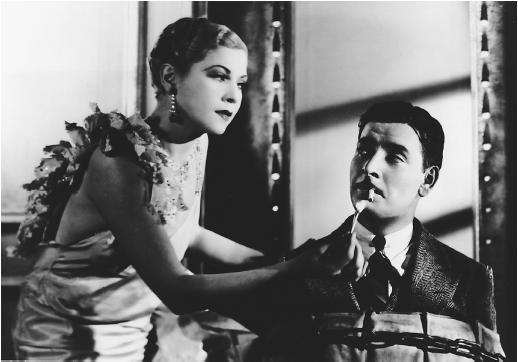
Colman and Tashman: rare highlights.
There isn't much to get excited about, character-wise, elsewhere either. Drummond himself is reasonably suave and dashing, in the James Mason mould, and he gets most of the film's best lines. Colman has good fun with the role, giving easily the best performance, and does have a charm which adds some creedance to the 'Drummonditis' (as Algy terms the attraction that Drummond holds) that befalls Phyllis. Bennett doesn't get to do much as the damsel in distress, and is overshadowed by Lilyan Tashman as Irma, the alluring siren charged with kidnapping Phyllis's uncle.

As far as evil plans go, the one that Irma has hatched along with her beau, Peterson, and the sinister Dr Lakington, is poor at best. They apparently founded a hospital (and hired a staff of goons, mind you), solely with the intention of kidnapping the rich Mr Travers, drugging him, and getting him to sign over his fortune to them. It's a plan they've gone to little effort to hide from Phyllis, and one wonders if it is really worth the trouble. Nevertheless, Tashman, a mere 20-years-old at the time, is good value as the beautiful vamp calling the shots.

The idea of an upper-crust war vet foiling evil plots and getting the girl is one I can get behind, but the problem here is that there just isn't anything clever, either about the plot, or the way Drummond saves the day. He just kind of strolls in to these situations, exchanges a bit of banter with the villains and strolls back out. At one point he and Algy switch clothes to try to throw the villains off, but the idea is never carried out to a satisfying end. The script, also, is subpar- none of the humour has aged well, and beyond that the characters often act completely unbelievably. That is none more the case than when Phyllis tells Drummond that she wants to let the villains escape, solely because she really believes that Irma loves Peterson, and, 'women do that. They fall in love'. This woman also kidnapped your uncle, and you, drugged him, and then tried to kill the both of you!

The director does do some interesting things with shadow throughout the film. For example, Drummond's fight with Dr Lakington towards the end of the film plays out entirely in shadow, so we are spared the horrors that the onlooking Phyllis witnesses. Beyond these flashes, this very much looks like a film of its time period, rickety and rough around the edges.

It's easy to romanticise early cinema, but I dare say there were a couple of hundred films better than this made last year. 2 stars.

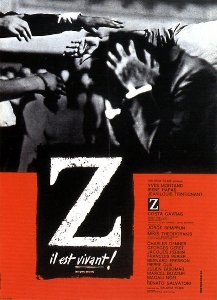
I didnt' even realise the second film I'm going to talk about was eligible for this project. I watched it as part of my 'best of the 60s' project, and only later found out that it was Academy Award-nominated for best picture and best director (as well as other awards). What makes that unusual is that that was a rare instance of a foreign language film being nominated in the Best Picture category. I'm talking about Z (1969, Dir: Costa-Gavras).

And what an international flavour this film has, with its Greek director (real name Konstantinos Gavras), Algerian location shooting, and mainly French cast. This political thriller was based on the real-life assasination of a Greek doctor, a member of a left-wing political party, and consequent takeover of the country by the right-wing military. The film gets its title from the use of the letter Z in protest graffiti against the military-rule; Z means 'He is alive' in ancient Greek.

Costa-Gavras' film takes place in an unnamed republic, and begins with a right-wing general comparing socialism, and left-wing activism, with mildew, and calling it a disease that needs to be treated. From there we begin to see the gathering of the left-wing party members, who are awaiting the arrival of Z, their leader, played by Yves Montand, in anticipation for an anti-war speech that he is scheduled to make in the city. The director sets his stall out early, his staccato editing and always-moving camerawork giving the film the feel of a documentary or television news report. In these early stages, we see the frustrations of the peaceful opposition party, as they are told that their meeting hall is no longer available, and several of their supporters are attacked by government-hired goons. All the while, the even temperament of Z is established, as, despite a threat on his life and these other signs of violence, he spells out his intentions to go ahead with his speech.

It is after delivering his speech that Z is murdered. He is struck on the head with a club by a man sitting on the bed of a passing truck, and collapses in the street surrounded by protesters, supporters, and the complicit police. This is a masterful sequence, and one that is returned to throughout the film as new details about what really happened are revealed, and separate accounts of events are told to the Examining Magistrate (a brilliant Jean-Louis Trintignant).

It is the Examining Magistrate who takes centre-stage from this point forward, an honest man who is looking to get to the truth of Z's death, all the while fighting against the lies of the military government. The film also focuses on Jacques Perrin's photojournalist, who sees a scoop in exposing the corruption at the heart of the tragedy. Other characters are pulled in; Z's widow, a crucial eyewitness who is attacked on his way to give testimony, and the two men who were paid to commit the murder. To its credit, the film never demonises, nor glorifies, any of these characters. They feel like real people, acting with real motivations, which is crucial as, in essense, these are real people. As the film's disclaimer says: Any resemblance to actual events, to persons living or dead, is not the result of chance. It is DELIBERATE.

The acting here is flat out great, from Montand, whose presence dominates despite only about 15 minutes of screen time, to Irene Papas as Z's widow, to Trintignant, and onwards. The film has a real sense of urgency that I would liken to Lumet's Dog Day Afternoon (1975), while the political content makes for an obvious comparison to All The President's Men (1976). Like that film, it takes very complex, serious political subject matter, and weaves it into a taut thriller, which builds up to almost unbearable levels of suspense. Z is an important film with an important message, one that is unfortunately still to be learned in so many corners of the world. I give it 5 stars.

In ATLI... #15, I'm going to take a look at another important piece of political filmmaking from across the globe. Until then, here's looking at you.